
Facing The Challenges of Discrimination and Migrant Integration
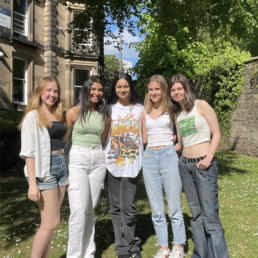
Written by Isabelle Watts
We are a Young Economic Summit Team from Sheffield Girls' who have reached the UK national finals. This is a topic we are all passionate about, and we have come up with a solution to reduce the discrimination migrants face.
As part of the Young Economic Summit we have researched the challenges migrants face and have developed a solution to mitigate these challenges. We are passionate about mitigating the discrimination migrants face and ensuring that they feel welcome into the countries which they choose to migrate to.
What challenges do migrants face?
Migrants face many challenges when they migrate due to discrimination from domestic born citizens. The media often fuels the discrimination by oversimplifying, misrepresenting or embellishing stories in order to attract attention. Consequently, people’s perception of migrants becomes negative and in many countries, such as the UK, migrants are seen as poorer, less educated and more likely to be unemployed than is the case. This creates barriers between migrants and domestic born citizens as they have pre made judgements of what they believe migrants to be.
However, it isn’t just the media that is exacerbating the challenges migrants face; it is also the policies implemented by the government. In recent weeks, the government has announced a new policy whereby any adult who comes to the UK without authorisation could be considered for relocation to Rwanda. Not only does this policy take away refugees’ control of their own lives and makes them more vulnerable to smugglers and traffickers, it also creates the idea that countries can pay to get rid of the responsibilities they signed up to under the 1951 Geneva Convention.
The desired situation:
The desired situation is a cohesive society where migrants and domestic born citizens are integrated and migrants feel welcomed into a country. Whilst migrants may inevitably face challenges, the aim is to try and support them as well as possible and remove the discrimination and intolerance of our society.
How to reach the desired solution:
One way in which we are trying to reach the desired situation is by conducting PSHE lessons on migration. In the long run this would reduce the discrimination migrants face as children will be taught what the different types of migrants are, what challenges they face, how to spot misinformation, as well as addressing the biases they may have already developed. Moreover, a supportive atmosphere will be created which encourages children to talk about their cultures and be proud of them. It is imperative that these lessons take place in primary school as by the age of 12/13, attitudes to race are fixed and become increasingly harder to alter. Although migration is in the PSHE curriculum, it isn’t compulsory and many schools avoid it. Therefore, we propose that set lesson plans are made which are compulsory to teach in PSHE lessons.
Another aspect of our solution is a widespread social media campaign reducing the misinformation spread about migrants. As part of this we have created eye catching social media posts that have facts that break down the stereotypes surrounding migrants. Consequently, people’s perception of migrants will begin to change and prejudices will be broken down.
Overall, we propose a twofold approach that takes into account the short and longer term. The national anti-racism media campaign will reduce discrimination in the short run, whilst the PSHE lessons will have a longer term effect. We believe that this is the most efficient strategy of reducing the discrimination migrants face due to misinformation, and allowing society to become more cohesive.
Please visit our website to find out more about our research, and fill in the form to show support for our solution.
Website:https://sites.google.com/she.gdst.net/migrant-integration-challenges/home
Form:https://docs.google.com/forms/d/1p363lLoHvigT2xWaZ0GnmNlQ-EOUrSsasSRbOsjKiG0/edit
Bibliography:
- Conzo P and others, ‘Negative Media Portrayals Of Immigrants Increase Ingroup Favouritism And Hostile Physiological And Emotional Reactions’ (2021) 11 Scientific Reports
- ‘What Are The Predominant Stereotypes About Immigrants Today?’ (Re-imagining Migration) <https://reimaginingmigration.org/what-are-the-predominant-stereotypes-about-immigrants-today/> accessed 15 May 2022
- Beirens H, and Davidoff-Gore S, ‘The UK-Rwanda Agreement Represents Another Blow To Territorial Asylum’ (Migration Policy Institute, 2022) <https://www.migrationpolicy.org/news/uk-rwanda-asylum-agreemen> accessed 15 May 2022
- Beirens H, and Davidoff-Gore S, ‘The UK-Rwanda Agreement Represents Another Blow To Territorial Asylum’ (Migration Policy Institute, 2022) <https://www.migrationpolicy.org/news/uk-rwanda-asylum-agreemen> accessed 15 May 2022
- Barnes D, ‘Why Helping Children Understand The Complexities Of Migration Is Vital’ (Teachwire, 2022) <https://www.teachwire.net/news/why-helping-children-understand-the-complexities-of-migration-is-vital> accessed 15 May 2022
- ‘Plan Your Relationships, Sex And Health Curriculum’ (GOV.UK, 2022) <https://www.gov.uk/guidance/plan-your-relationships-sex-and-health-curriculum#using-external-agencies> accessed 16 May 2022

DEI in an International Setting
Written by Esther Mustamu-Daniels
Esther Mustamu-Daniels has 20 years of teaching experience working in London and the Middle East as a Class teacher, Education officer, Middle Leader and DEI Lead. Currently working at British School Muscat, Esther co-leads the DEI work across the whole school.
Many international schools are on or starting their journey of awareness of diversity, equity and inclusion. Because cohorts in these schools are so diverse by nature, often staff feel that there are no problems and that racism/discrimination is not a factor in the schools. This is usually very far from the truth.
Be brave; be vulnerable and start the challenging and honest conversations that are needed for change to take place.
Because of recent high profile events, diversity, equity and inclusion is a necessary space in all educational settings and that international schools, who send their alumni to universities all over the world, would do well to support, inform and equip students with knowledge and language to engage with the different topics around DEI.
How do schools start tackling, delivering and addressing these needs?
Start with the staff: build open conversations. It is important to know that not everyone is at the same place on their journey and also that there are different opinions. Gathering the ‘tone’ of your school as well as allowing safe spaces to share experiences is a key factor. What is important is that this is not only talk; action is also needed. This is an emotional and difficult journey so be sure to provide space and time to reflect and learn.
Action: Build a plan of how you will move forward. You may need to conduct a survey or gather some research and data from your school’s stakeholders to help you focus on what the priorities are in your specific setting. Are there specific needs or policies that need addressing first? This will help to focus on each step and also assign roles or tasks to specific people. This should be flexible so that it can be adapted along the way.
Leadership: Is there someone leading the work? Do SLT support and value the work being done? Does your leadership understand the why and how? This is important because without this it is extremely difficult to implement significant change. Leadership needs to take accountability for the work being done in their school. Is that person being paid?
Support: This is also an essential element. Who is supporting the people completing the work? Are they being emotionally supported as well as practically? The people leading or sharing this work may have been personally impacted or triggered by the issues raised; how are they being supported?
What is important to note is that action in any form is good and a positive step in the right direction. Addressing and tackling these issues will take time and for long lasting impact will need to be embedded in the culture of your school or environment. This is not a badge or a t-shirt; this is a cultural shift of readdressing mindsets.
If you are involved or starting up; learn, speak and support. Being an ally and everyone doing their part is imperative. There is so much work being done at the moment. Twitter is an excellent source of examples, webinars and organisations that can support you on your journey.
Review of Diverse Educators: A Manifesto, ed Hannah Wilson and Bennie Kara (University of Buckingham Press, 2022)
Written by Dr Jill Berry
Thirty years teaching across six different schools in the UK, state and independent, and was a head for the last ten. Has since completed a doctorate and written a book.
This book is a collaborative tour de force. Rarely have I read anything which has made me think as much as this book has. Tapping into the experiences of a wide range of writers whose lives have been, in so many ways, quite different from my own, has been sobering, humbling but ultimately energising. This book deserves to be widely read, robustly discussed and, crucially, its key messages need to be acted upon so that we work to change our world for the better – for everyone.
I appreciate that this is not necessarily a book most people would read from cover to cover. It is a weighty tome! It devotes one section to each of the nine protected characteristics, adds a chapter on intersectionality, a prologue and an epilogue. It is an amazing accomplishment, bringing together the views of 125 contributors, including the ten chapter editors, and Hannah and Bennie, who all share their stories and their perspectives. The book goes far beyond the exploration of personal stories, however.
I imagine that many people would identify a specific section, or several sections, about which they wished to develop their knowledge and understanding, and would focus on that part of the book. But I want to advocate for reading it all. Even if you feel that there are certain characteristics that you believe you fully understand and appreciate – perhaps you share them – I suggest that every section has something to teach us. And as you make your way through each separate section, you appreciate the connections, the echoes and the common ground, reinforcing the essential humanity which underpins this story of ‘difference’. As Bennie says in our Myatt & Co interview about the book: ‘No-one is just one thing.’
The range of contributors is one of the reasons this book resonates. Different contributors ranging from teenagers to the considerably more mature contingent; UK and overseas perspectives; primary, secondary and FE educators; state and independent sector teachers and leaders; many who share a number of protected characteristics offer their experiences, views and their own learning with generosity, honesty and courage.
Many of the stories are strongly grounded in research, and the book contains a great number of references, on which the contributors draw and which they share for those who wish to explore further through additional reading. It is also eminently practical, with key takeaways, key questions and specific commitments at the end of each chapter and a final section in which Bennie and Hannah make clear how readers can act on their reflections as they have worked through the different sections and what they have learnt as a result. They exhort us to consider: what difference will this make? It made me think of Zoe and Mark Enser’s words in ‘The CPD Curriculum’: “CPD does not happen through a particular input of information; CPD occurs through what happens next.” When you get to the end of the book, you are strongly encouraged to think about what action you will take as a result of the experience.
I strongly recommend ‘Diverse Educators: A Manifesto’. Bennie Kara’s words in the epilogue mirrored perfectly my own response to the book: “Throughout the book, I have been struck by the honesty of the contributing authors… I have seen in the writing parts of myself – feelings, thoughts and experiences that have served to demonstrate how we as education professionals have complex and interweaving experiences…In reading these chapters, even if I do not share a particular person’s protected characteristic, I have recognised the intensely human need to be heard.”
I would encourage you to make the time to read the whole book. I am confident that you won’t regret it.
Being Transgender in the UK, Transphobia and How to be Inclusive
Written by George Hughes
Senior Education, Training and Strategy Officer currently working for EqualiTeach. Having previously worked as an English teacher, George has a passion for writing. They are currently studying an MA in creative writing at Manchester Metropolitan University and hope to one day publish their own children's novel.
With roughly 200,000 – 500,000 trans people living in the UK (Government Equalities Office, 2018), and more celebrities coming out as gender diverse, trans people have become a popular subject for discussion. While many transgender people are celebrated around the world, discrimination and transphobia is still being faced daily with devastating consequences. This blog is about being transgender in the UK, what we mean by transphobia, and what we can do to be inclusive of all members of the community.
First of all, what is meant by the term transgender?
The word transgender is a term which describes people whose gender identity is not aligned with the sex they are assigned at birth.
What is gender identity?
A person’s gender identity is their personal and internal sense of who they are regardless of their hormones, internal and external sex organs, and chromosomes. Gender is no longer regarded as a binary model wherein people have to identify as either man or woman; it is instead a spectrum in which a person is able to freely identify themselves as one of over 60 different gender identities. (Abrams and Ferguson, 2022)
What is transphobia?
In simple terms, transphobia is negative feelings, attitudes or actions against people who identify as transgender. It also covers those who identify as nonbinary, transsexual or androgyne. Transphobia can be seen in many different forms and can range from inappropriate language, prejudice-related bullying, to full-blown violent attacks.
The transgender community have become a topic more frequently discussed by the British tabloids. Panic and prejudice have been propagated by the press and gender critics. Research carried out by Forbes (2021) has claimed that 375 transgender people were murdered in 2021 – twenty five more than the year before. According to records, this is the ‘deadliest year of violence against gender diverse people since records began.’
In August 2020, the Equality and Human Rights Commission published a report which showed the public’s attitudes to trans people. From the data, it is clear that many people do show a positive attitude. When asked to choose words to describe their feelings towards trans people, many chose words such as ‘respect’ and ‘admire’. However, there is still a percentage who selected ‘pity’, ‘fear’, ‘disgust’ and ‘resentment.’
So why is there a growing level of fear-mongering and intolerance?
Shon Faye (2021) states, “By and large, the transgender issue is seen as a ‘toxic debate’, a ‘difficult topic’ chewed over (usually by people who are not trans themselves) on television shows, in newspaper opinion pieces and in university philosophy departments. Actual trans people are rarely to be seen.” As a trans person, it is hurtful to have my existence debated by people without any lived experience. How often do we see ourselves reflected in the media, and not being spoken about by a cisgender person?
As someone who has recently come out as trans, I am getting used to the daily microaggressions and comments about people’s ‘transness’. People have a lot of questions! The most common questions are “When you are having surgery or taking hormones?” as that is what people assume is everyone’s next step. It is not enough that we exist, we have to exist in a way that everyone expects us to.
What is it like being trans in the UK?
While there is lots of support, it is also incredibly difficult. In order to even be diagnosed with ‘gender dysphoria’ (the feeling of discomfort or distress that might occur in people whose gender identity differs from their sex assigned at birth or sex-related physical characteristics) and start medically transitioning, you have to be assessed by two psychologists with expertise in the area of gender development. These can be in excess of £1000 and that is just to get a piece of paper with your ‘diagnosis’ on. If you were to go through the NHS, wait times for the first appointment alone are a minimum of eighteen months – and that is if you are fortunate. Once you have your referral, you are faced with more waiting to see a specialist in that area. Even privately, waiting lists for hormone replacement therapy are a year long. So, while some of us will be going through hormone therapy or surgery, each time we are asked, it reminds us of the long waiting list ahead and the months to follow where we still don’t feel at home in the body we are in.
How can people help?
One way, is to avoid gendered language
Reflect on the language you are using. Using gendered language such as ‘boys and girls,’ ‘lads’ and ‘ladies and gentlemen’ can be alienating for those who identify as gender non-conforming and gender diverse. Being referred to as ‘miss’, ‘ladies’, or ‘madam’ makes me feel uncomfortable every single time.
To avoid this, use vocabulary such as:
- Everyone
- People
- Folks
These terms are more inclusive and do not focus on someone’s gender or gender identity.
Use chosen names and correct pronouns
A person’s chosen name and pronouns are an important part of their identity. If someone has asked you to use these, ensure you are doing so in order to respect the person’s gender identity, and to ensure that they feel included and valued. Chances are, someone has spent a lot of time thinking about their name, so please use it!
If you’re not sure of someone’s pronouns, ask! I have always really appreciated it when someone has asked me what my pronouns are. It immediately puts me at ease. If you are struggling to remember, have a go at saying their names and chosen pronouns aloud.
For example:
Sam is a trans man, he is using he/him pronouns.
Jamie identifies as non-binary. They use they/them pronouns.
What is a deadname?
A deadname is the name transgender people may use to refer to the name they were given at birth. Some people may refer to it as their birth name. You should not ask what their deadname or birth name is, unless it is for legal or financial reasons. If someone wants to share this with you, they will. If you know someone’s birth name, don’t use it. Use the name that the individual asks you to use.
What if I call the person their birth name or use the wrong pronouns?
People make mistakes all the time. It’s okay! If you happen to do this, apologise and move on. If someone corrects you, say ‘thank you’ and move on. It may take a while to remember if you have known the person a while. The most important thing is to show that you are trying.
What if I’m talking about someone before they transitioned?
Always refer to the person using their chosen name and pronouns unless they tell you otherwise. It is respectful to only use what the person is happy with.
And finally, if there is a question that can be answered by Google, search for it!
I started out thinking I had to be everyone’s guidebook to being transgender. I misplaced nosiness for support and said that I was happy to answer any questions at any time. I have since realised that it is not my duty to educate others; that is something that has to come from them. While I am more than happy to have conversations on being transgender, rights, discrimination and equality, I am not here to help people understand what being transgender means. It is tiring.
If I was to use a metaphor to describe being trans, it would be this:
Being trans is like floating around in a rubber ring in the ocean. You can see everyone else on their islands happily being themselves and being free. No matter how hard you paddle, you can’t get there. You’ve never visited and you don’t know how to. People keep telling you to visit, but you still don’t know how. Accepting you are trans allows you to start building a bridge from your rubber ring to the island. With each step you take to becoming yourself, another part of the bridge is added, until it is finally completed. When people call now, you can then cross the bridge and live on that island. It is then that you feel like you’re home.
The Power of the Community
Written by Dena Eden
English teacher and writer based in Norfolk. MA in Educational Research and currently working as an English Standards Leader.
I signed up to the recent #DiverseEd conference knowing I would hear about some brilliant examples of Diversity, Equity and Inclusion work going on across education; I didn’t expect to finish the conference feeling empowered. Listening to authentic voices and lived experiences encouraged me to reflect on my own, and has given me the confidence I needed to forge ahead with necessary change.
As a cis white person I recognise my privilege. As a woman, I have experienced the frustration of my ideas not being taken seriously until a man repeats them. My choice on how to present physically also means people have undermined my intelligence and assume I enjoy shopping and ‘partying’ – they were someone’s actual words. They are surprised when I share my achievements and professional life before teaching. They are even more surprised when they find out I’m gay. Ironically, the part of my identity which is a ‘protected characteristic’ has been met with more positive outcomes than negative. When people ‘find out’ I am gay, women treat me more warmly and men take me more seriously. But that’s a whole other blog post.
I want to share my own experience to try and explain the effect the #DiverseEd conference had on me: despite being invested in creating a truly inclusive environment for a long time, I didn’t feel ‘diverse’ enough to be the person to do that – but at the same time also felt a huge pressure from being part of the LGBTQ+ community to be a voice for those who don’t speak up. Growing up in Birmingham and then living and working in both Mexico and the USA means that I have experience of living life in the role of the ‘other’ – but also that I have always worked in environments rich in diversity. Embarking upon a career in education in a significantly less diverse area of the UK was a shock to me.
Despite absolutely loving where I live and work for lots of reasons, it does continue to surprise me when I witness the problematic attitudes and language used when talking about diversity and inclusion. Discriminatory language is used without understanding why it is a problem and the pervasive idea that ‘real’ prejudice is overt and/or violent means many people do not recognise their privilege: Prejudice hides behind ignorance; tokenism acts as acceptance; tolerance is sufficient.
Understanding inaction: providing solutions not problems.
My experiences have frustrated me and as a result, I approached leadership in the Trust I currently work for to start a conversation; it was met with enthusiasm and support and has led to me setting up an Inclusive Communities group working with outstanding colleagues invested in making long lasting change.
Up until the #DiverseEd conference, I had some idea of what I wanted us to do – but have been apprehensive. For me, a truly inclusive environment has always been about addressing the root of the issue – people’s mindsets. Until people are willing to admit both their own privilege and the importance of the work that needs to be done, nothing will change.
Watching the conference helped me to reflect on previous conversations and helped me to understand that I had been too concerned with losing respect or upsetting others by voicing how crucial the work around diversity, equity and inclusion really is. But without action, we are conversationalists not activists; my thinking has now shifted from worrying about reactions to focusing on my own actions.
Before the conference, I felt like the battle was in trying to get people to appreciate the importance and immediacy of the work that needs to be done – it isn’t work with immediate measurable outcomes for example. After watching the conference, I feel validated in arguing that there should be no such battle. The immediacy and importance of this work is not an opinion – it is a fact.
So moving forward, rather than focusing on whether the changes can be made, I am focusing on how they will be made. Working with an incredible community and calling on the expertise of my colleagues, we are going to approach people with solutions rather than problems. This is where we are going to start:
- Looking at policy within schools and across the whole Trust.
- Educating our staff to be able to challenge one another and our young people – this will be led by training from authentic voices sharing their lived experiences.
- Recognising multiple stakeholders in this work: parents, governors and HR should be included in our approach to EDI.
- Working with our incredible curriculum team to explore ways we can include balanced and meaningful representation into our existing work.
It was overwhelming to think about the work that needed to be done; now I’m excited to get started. We deserve genuine support, not allowances; to be comfortable as well as safe; celebration, not tolerance.
Limp Handshakes and Auditory Bias: My Process of Applying for Headship
Written by Kevin Carson
Headteacher at The Royal Masonic School for Girls. A learner, an English teacher, and a dad to 2 fab girls. Originated in Liverpool, enjoying living in the Shires.
I have been attending a monthly Diversity, Equity, and Inclusion leadership programme with Diverse Educators since April 2021. It is led by @Ethical_Leader and @Angela_Browne, and it has uplifted, educated, and inspired me every month.
Hannah and Angie are clear and correct that DEI work is safeguarding work, that well embedded DEI makes school communities safer places. The aim of their programme is not to rush into anything in a knee-jerk way, but to listen, reflect, learn, and then start to put together a 3-to-5-year plan that works for each school: carefully planning sustained change over time.
At the start of this week’s session, mention was made of an excellent candidate for headship who so far has not been appointed and there was a feeling that this may at least in part be connected to his race and from that perhaps also in part to his strong accent. This anecdote stayed with me after the session, conscious as I am that over 96% of male and female headteachers in England are white, and with my own awareness of how frequently my accent was referenced when I was applying to be a Headteacher.
I have decided to share a couple of anecdotes relating to my applications for the post of Head at independent schools when my accent was considered a relevant factor.
I once applied for a Headteacher post where afterwards I was told by the head-hunters, “You were the preferred candidate, the first choice, but the Board have decided not to appoint. They were quite vague and evasive with us about why this was, and they could only give reasons such as ‘His handshake wasn’t strong enough’, whatever that means. I think you can draw your own conclusions from this, Kevin.” A few months later, the Bursar at that particular school later told me straight that the Chair of Governors didn’t wish for somebody from my background as Head of ‘his’ school.
On another occasion I attended a training session with one of the head-hunter firms, as part of a course for half a dozen applicants who they felt were close to headship. Afterwards, the course leader told me, “We agreed that you were the strongest candidate from the process we saw today. You are 100% ready to be a headteacher, but we think that you should seriously consider booking yourself in for elocution lessons because your accent will be the reason that you are not going to be appointed.” As an English teacher I know enough about language, culture, and identity to be able to reply that if a school didn’t wish to take me as I am then they weren’t the right school for me and I wouldn’t wish to be their headteacher.
For those who do not know me, as my About Me section says, I grew up in Huyton, Liverpool, a working-class area that is in the second most deprived borough in England, and I have quite a strong Liverpudlian accent. The Chair of Governors at my then current school did make a decision to directly address my accent in his reference, raising it as a potential consideration before clarifying why this shouldn’t be a factor in a Board’s thinking, pre-emptively calling this out as it were.
I am a straight, white, male headteacher of an independent school. I have a 1st class degree, and an M.Phil. from Trinity College, Cambridge – there is a whole bunch of privilege there. At the time of the anecdotes above I was also Interim Head of The Grammar School at Leeds, a large, diamond model school. I had quite a strong CV on paper, and to be honest I suspect that in a comparable way to my accent wrongly being deemed relevant at interview, it is also not inconceivable that my educational background helped get me to the interview stage. Some Boards like this kind of thing, taking it to signify far more than it should.
I want to be clear that this is not a post about bias and class in the independent sector. I have worked in four independent schools, valued them all, and have found them all to be far more egalitarian workplaces than some might imagine. Very many people working in the independent sector desire to do social good and to help to create a more inclusive and sustainable world. More specifically, in RMS, I have found a values-led school with a strong ethos that is prepared to think differently about all aspects of education. I feel appreciated there for who I am, and my accent or social background aren’t referenced in relation to the job that I do because nobody feels they are relevant.
But I have shared a few of my experiences here, (and each of these are only from six years ago), as anecdotal evidence that bias is still out there in appointing Heads. The education system would be a better place if this were not the case, and we all need to consider the ways in which we can demonstrate commitment to a diverse, equitable, and inclusive staff community in our schools. For me, it was bias in relation to attitudes to social class, and a little bit of auditory bias. The government figures from 2019 indicate the extent to which this is a far greater issue in relation to race and ethnicity.
The data shows:
- There were around 22,400 headteachers in 2019, and over two-thirds of those (around 15,100) were women
- 96.1% of female headteachers were White (92.6% White British, 1.7% White Irish and 1.8% White Other)
- 97.0% of male headteachers were White (92.9% White British, 2.1% White Irish and 2.0% White Other)
A few final thoughts on this topic for now from me:
- I hope and want to believe this bias and prejudice is receding, gradually diminishing. I believe in the transformative power of education as a force for social change that makes a positive difference. Interestingly, the Foundation that found my background not the right fit for them and that blamed it on my limp handshake have changed their entire Board since then, and there are now seven women and three people of colour on a more diverse Board there. You would like to think this would not happen again.
- @jillberry102 was a great source of advice and support throughout my applications for headship. She always said that in the end you find the right school for you, the right fit for you. I do think there is something in this. I can now view my earlier experiences as lucky escapes.
- There is a great deal I have taken from the Diversity, Equity, and Inclusion leadership course, both from the leaders and from the brilliant colleagues that are attending with me from both sectors, and from the UK and overseas. I am sure I will write about this learning again, including about how we strive to apply it at RMS. We have just appointed two DEI leads at RMS – they are brilliant colleagues who will do a great deal of good in this role. My first show of support for them was to sign them up for Hannah and Angie’s training course with Diverse Educators.
Still a Challenge: Raising Awareness of and Tackling Islamophobia
Written by Saira Hassan
Senior Education, Training and Strategy Officer at EqualiTeach. Trustee for CareStart. Saira is determined to create a better future for disadvantaged individuals so they can showcase their talents, always striving to pass on her knowledge, experience and expertise to others.
November is Islamophobia Awareness Month, established in 2012 ‘to deconstruct and challenge the stereotypes about Islam and Muslims’. In this blog post I will be sharing some definitions of Islamophobia, real life examples, personal experiences and my thoughts on how we can reject and tackle Islamophobia to create a more inclusive environment for all.
What is Islamophobia?
So, what is Islamophobia? The All-Party Parliamentary Group (APPG) for British Muslims state “Islamophobia is rooted in racism and is a type of racism that targets expressions of Muslimness or perceived Muslimness” (All-Party Parliamentary Group, 2018). Alternatively, MEND defines Islamophobia as “a prejudice, aversion, hostility, or hatred towards Muslims and encompasses any distinction, exclusion, restriction, discrimination, or preference against Muslims that has the purpose or effect of nullifying or impairing the recognition, enjoyment or exercise, on an equal footing, of human rights and fundamental freedoms in the political, economic, social, cultural or any other field of public life.” Islamophobia has become a systemic and institutional problem preventing many Muslims from progressing in the workplace, having a complete sense of freedom and being able to feel comfortable within school, the workplace and general society.
One sector where we can clearly see that Islamophobia is rampant is within the media. Miqdaad Versi, Director of Media Monitoring at the Muslim Council of Britain has singlehandedly spent many hours highlighting the gravity of the situation. Miqdaad has been described as the “UK’s one-man Islamophobia media monitor”. A 2018 Guardian news article on Versi’s fight against Islamophobia revealed that out of 24,750 articles on Muslims that he had recorded since August 2016, 14,129 were negative. A 2007 study revealed that 91% of articles on Muslims and Islam published in one week were negative painting an inaccurate and negative picture of Muslims in the minds of readers. Baroness Sayeeda Warsi has stated that the media are complicit in the increase of Islamophobic views and attacks because of the “daily poisoning” exhibited against British Muslims by the media.
“Still a Challenge for Us All”
Often people may have an unconscious bias towards Muslim students or colleagues which clouds their judgement. The Runnymede Trust published a report in 1997 titled ‘Islamophobia: A Challenge for Us All’ which highlighted the extent of Islamophobia across the United Kingdom. 20 years later they published another report ‘Islamophobia: Still a Challenge for Us All’ which reiterated the extent of the deeply entrenched Islamophobia . The report states “As with many Black and minority ethnic groups, Muslims experience disadvantage and discrimination in a wide range of institutions and environments, from schools to the labour market to prisons to violence on the street.” There are now countless case studies that highlight the mistreatment that Muslims and those perceived to be Muslim are facing.
“As a visibly Muslim woman the shock I felt was evident instantly. I had to take a moment to absorb what I was hearing. As the workshop lead, I felt I had to pause before hearing other experiences of identity-based bullying in case I could no longer carry on.”
In the last fortnight I have personally heard examples of Islamophobia when delivering workshops in schools. Most recently, whilst discussing identity-based bullying, when asked to share an example of where they had witnessed Islamophobia, a Year 8 student revealed a time when a Muslim student volunteered to take part in a play during a History lesson, another student shouted out that the play was not about terrorism, therefore the Muslim student wasn’t required. I have since shared this example with other settings and the shock, horror and heart-breaking feeling that I experienced the first time has not disappeared. Other examples included Muslim girls having their hijab pulled off. As a visibly Muslim woman the shock I felt was evident instantly. I had to take a moment to absorb what I was hearing. As the workshop lead, I felt I had to pause before hearing other experiences of identity-based bullying in case I could no longer carry on. I did not want the students to stop sharing their experiences, but I had to take a moment to compose myself. This was the impact of just hearing the incident, I wondered how the young students who experienced these forms of Islamophobia had felt in those moments. Did anyone stand up for them? Were they confident enough to challenge this themselves? Did the class teacher step in and use this moment as a learning tool to educate the class about Islamophobia? Did the classroom teacher check-in with the Muslim student and other Muslim students in the classroom? Has the school recorded this incident? Many questions whizzed through my mind.
What surprised me further was the lack of intervention from teachers and other members of staff, and the lack of awareness of how to deal with identity-based or prejudice-related bullying. Our advice when prejudice-related incidents take place is for teachers to always intervene and challenge, as well as record each incident to see trends and find solutions to prevent prejudice-related incidents. Each school and educational setting should have a robust procedure in place to tackle any type of prejudice-related bullying. Although there are many teachers that would intervene, it is unfortunate that many feel unequipped to do so, or simply ignore the matter.
Islamophobia in the workplace
Within the workplace many Muslims have also experienced Islamophobia. I have personally experienced a lack of understanding of my religion, my choices to wear the hijab, and judgement for choosing to fast during Ramadan by previous employers. For example, at that age of 18 whilst working for a leading Law firm, my manager often made jokes regarding fasting and would often say no one could see me therefore I could break my fast. In another incident, a joke was made about removing my hijab to show everyone my hair. I often wonder why these individuals felt entitled enough to make such derogatory comments about my religion and religious choice. More recently in my previous position, I and other Muslim colleagues often had lengthy discussions about how we would ask for time off for Eid as there was a culture of negativity towards asking for a day off to celebrate with our loved ones. I recall many Muslim colleagues choosing to work rather than have the difficult conversation to request leave. Other colleagues were asked to cancel other annual leave to keep a day spare for Eid and many were told to teach their morning lessons then have the afternoon off. If supply staff could be called in at the last minute to cover sickness, why could supply staff not be given a few days or weeks’ notice to allow for a Muslim teacher to celebrate Eid?
A research report co-compiled by Dr Suriya Bi and Muslim Women Connect found that 47.2% of women stated they had encountered Islamophobia and discrimination as a challenge in the workplace. One woman revealed: “Colleagues would ridicule me when fasting, asking ‘are you still starving or whatever’. Colleagues would ask me to talk about Muslims and things she’d see in the media, as if I was the spokesperson for the entire religion. Colleagues would jokingly put alcohol glasses in my face asking if I wanted to drink it. Colleagues would get annoyed when I said I couldn’t go to the pub.” (Muslim Women Connect and Bi, 2020: 29).
Furthermore, members of the Muslim community are often expected to speak up when terrorist organisations misuse the religion of Islam. Speaking up for your community, or religious group, is a very personal choice, but Muslims are expected to condemn terrorist attacks as if they are to blame or have a part to play. This can have a detrimental impact on someone’s mental and physical health, as well as forcing them to question their position in the environment.
The gravity of attacks against women and girls
Muslim women and girls are often singled out as the focus of Islamophobia rhetoric and attacks. The 1997 Runnymede Report highlighted the gravity of attacks against women. The anniversary report in 2018 further explained how Muslim girls and women continued to face even more Islamophobic hate, especially concerning their freedom of speech and dress. Often women are mislabelled as oppressed and their choice to adopt the hijab (headscarf) or niqab (veil) is framed as forced and disempowering. Muslim men are then labelled as misogynistic and controlling (Runnymede Trust, 2018). Stereotypes like this are denying Muslim men and women of their agency. Increasingly, men and women are bravely sharing the Islamophobic hate they have experienced.
“Islamophobic comments from an impolite customer regarding the hijab telling me that she wished I wouldn’t wear ‘that thing’ as British women had fought for the right to vote and do what they wanted and not for people ‘like me’ to have to wear it.” (Muslim Women Connect and Bi, 2020: 29).
Most recently, Zarah Sultana Labour MP for Coventry South bravely shared her experience of receiving Islamophobic hate which you can watch here. Zarah Sultana continues to fight against Islamophobia within politics and continues to encourage more young Muslim people to join the political arena to ensure there is fair representation.
From these testaments and my personal experiences it is clear that Islamophobia is still a problem. I recently read a personal account of an employee being treated unfairly because they requested time to perform their daily prayers and was timed throughout their break. The afternoon prayers take approximately 10 minutes to complete, often even just 5 minutes. The image below sums up exactly how some organisations need to change their views towards any type of religious observance, and what they should be doing to be more inclusive for their Muslim employees and Muslim students. It is extremely important that we all work together, as a collective, to undo the unconscious bias that revolves around Islam and Muslims, to work towards a more accurate understanding of Islam and Muslims across the world.
Going forward
Organisations
- Engage in EDI training
- Don’t force any of your Muslim employees to be the spokesperson for their community
- Do ask how they are when horrific events happen where the Muslim community feel blamed or held responsible by others, offer support and guidance, they might want to discuss something but there should be no pressure for them to act as a spokesperson.
- Evaluate your policies – are they inclusive for all?
- Ensure that there are clear mechanisms where employees can report discrimination and harassment and clear procedures as to how these are dealt with, which all managers are aware of and implement consistently
- Create an inclusive environment which provides opportunities for employees to engage with their faith and accommodates time off for religious festivals
- Engage in anti-Islamophobia events and training
EqualiTeach can provide bespoke support for organisations doing this work. Find out more here: Workplace EDI support
Educational institutions
- Deliver anti-Islamophobia workshops with young people
- Create robust procedures to tackle prejudice-related incidents and bullying and ensure that all students and staff are aware of how to report incidents and have reassurance that these will be consistently dealt with and not dismissed
- Diversify your curriculum so that it is truly representative of the wider community and allows you to address any misconceptions young people might have about Islam or Muslims
- Ask all students if they would like to share parts of their faith and/or culture with the class – ensure this is a personal choice and not enforced on young people and that young people are not singled out or put on the spot.
- Invite Muslim speakers from all backgrounds to come and share their experiences with your students
Find out more about the services EqualiTeach provides to support schools with this work here: Equality services for education settings
How can we raise anti-racist leaders?
Written by Ayo Awotona
Ayo Awotona specializes in confidence building for girls in education. She does this through programs, workshops, and keynote speeches.
When it comes to speaking about race, white privilege, and colorism; things can often get a tad bit uncomfortable or even awkward, to say the least.
This is understandable. More often than not, these are difficult conversations for most people, and difficult conversations are often characterized by emotions such as fear, anger, frustration, conflict, and other strong dividing — not unifying — emotions. These emotions are often suppressed and can be released rather strongly.
Why is this?
It’s because emotions can run high on both sides, and there is room for the conversation to become quite heated on either or both sides.
This is just one perspective as to why uncomfortable conversations are hard.
So I hope that takes some pressure off of you depending on your curiosity as you first read the title to this blog post 🙂
So let’s dive into this simple (yet, rather complex) question.
How can we raise anti-racist leaders? That is, how can we empower our young people in the world today to make a change by first recognizing racism and challenging it in this seemingly never-ending cycle of systemic oppression?
Before I continue, I must add here that this question is not thrown out to one particular race. This is a question that’s being thrown to each and every one of us reading this (yes! Even me as a Black-British Nigerian woman), because the reality is… change starts with every single one of us. All races and denominations. Change looks different on each and every one of us – rather than a one-size-fits-all approach.
To kick us off with answering this question, it’s important for us to acknowledge/be reminded that children are not colorblind. Children are very much aware of racial differences.
Permit me to simplify how young children learn about race to:
- what they see (both directly and indirectly),
- what they hear, and;
- what they are taught (both at home and in school).
This is really encouraging because it means we (as educators and leaders) play a big role in positively influencing the trajectory of their lives.
Now let’s talk about developing an anti-racism strategy for our young people.
There are different ways to make a change so I’ll give 3 examples of practical things that can be done to help raise anti-racist leaders.
Behavioural Change
As leaders, we ought to know and lead ourselves before we lead others. This means we essentially can’t give what we don’t have. Here are some tips for being intentional about our own growth:
- Listen to other perspectives and de-center yourself
- Boost the voices of the marginalized
- Educate yourself
- Acknowledge your own privilege and propensity for unconscious bias
- Challenge discrimination, even when you feel scared
- Keep the conversation going
Raising Awareness
Sometimes, one of the most powerful things we can offer young people is awareness. This is where we’re focusing their attention on a cause or issue in the world (in this case, related to race). The objective is to increase their understanding – but of course, we must be in a position where we are practicing this ourselves.
Action Planning
A great way to empower young people to take charge of their own learning is through projects – whether this is through achieving tangible or intangible objectives. Action planning activities are designed to support students to build the necessary skills for work and life, as active local and global citizens.
So what could this look like?
Running a workshop where students come up with a project idea to take action on!
During the workshop and overall project duration, it’s important that we support students with their ideas, but steer them in the direction of what is realistic. It is important not to stamp out their creativity, but equally important to ensure students have a clear understanding of how their action plan can be S.M.A.R.T. (Specific. Measurable. Attainable. Relevant. Time-bound)
Some suggested questions to guide your students are:
- What issues do you see happening in your local community that make you upset/angry/you would like to change?
- What issues do you know of happening in your global community? Have you read or seen anything in the news recently?
- If you could change one thing in your local/global community, what would it be?
I strongly believe that for us to move in the right direction of raising anti-racist leaders, change starts with both you and me.
My name is Ayo, Ayo Awotona.
Let’s keep the conversation ALIVE!
Men, women and the rest of us: a brief guide to making university classrooms more accessible to trans and gender non-conforming students
Written by Kit Heyam and Onni Gust
Onni Gust: Associate Professor of History, University of Nottingham. Author of Unhomely Empire: Whiteness and Belonging, c.1760-1830.Kit Heyam: Lecturer in Medieval and Early Modern Studies at Queen Mary, University of London, freelance trans awareness trainer, and queer public history activist.
This is a guide for academic teachers who want to get the best out of their trans and gender non-conforming students, and to ensure that they can fully participate in the classroom and in their studies.
1. Avoid making assumptions
Don’t assume you know a student’s gender based on body-type, voice or even dress. If they do disclose their trans status, don’t assume that they have or will undergo any form of medical transition; ask them how you can support them. All you really need to know is how to address them.
2. Names and pronouns are all you need
Names and pronouns are all you really need to know from your students. For trans and gender non-conforming students, the name, sex or title on their student record may be wrong. Using a student’s ‘old’ name may force them to come out, which can be incredibly distressing as well as violating the Equality Act. To avoid this:
Names:
- Instead of calling out the register, ask students to either write or say their names.
- Be up-front with students and ask them to see you, or email you, after class if for any reason their name has changed.
- Online platforms often automatically display names from University records. Familiarise yourself with your university’s name-changing processes – and if there aren’t any, insist that they be put in place.
Pronouns:
- Even if you think it’s obvious, explain to students how you like to be addressed. This models the process for all students and makes it much easier for trans and gender non-conforming students to state their own pronouns. Regardless of whether you’re trans or not, it also sends a powerful signal, showing you’re aware you can’t tell someone’s gender just from looking at them.
- If you ask students to introduce themselves to the class, give them the opportunity, but not the obligation, to include their pronouns.
- Gender-neutral pronouns, which some students will use, include the singular they/them/their; ze/hir/hirs; fae/faer/faers. The list is growing: if you’re unsure, ask the student to model the usage for you, or research it online.
- If you get a student’s pronoun wrong, apologise, correct yourself and move on.
3. What if other students constantly misgender a student in your class?
If a trans or gender non-conforming student brings this to your attention, it may be worth taking that student aside and talking to them. If, as a transgender teacher, I suspect that this is active transphobia, I would probably ask a cisgender colleague to intervene.
4. How else can I make learning more inclusive?
Consider your syllabus. It may be necessary to teach material that uses outdated/pejorative language, or ideas, about gender and sexuality (and/or race, class and disability). Flag up the problems, explain to your students why these texts are necessary to engage with, but make it clear that you do not support these ideas and that you invite critique.
Think about how you’ll manage any resulting questions or disagreements. How can you help your students to create a trans-inclusive seminar environment without making them feel overwhelmed, alienated or defensive?
5. Pastoral care for trans and gender non-conforming students
Awareness of trans and gender non-conforming identities is moving at a fast, but very uneven, pace. While your students will hopefully have support at home and at university, that’s still not the case for the majority. In a recent UCAS report, 17% of trans university applicants reported having had a bad experience at school or college, and trans applicants were less likely than LGB applicants to have good expectations for university. The report recommends that universities and colleges introduce bespoke resources to support trans students.
Trans people remain disproportionately affected by mental health problems.If your trans and gender non-conforming students disclose mental health problems to you, treat them as you would any other student, butbear in mind the following:
- Not enough counselors or GPs are trans-aware; some have been known to do more harm than good.
- Specialist gender services have waiting lists of over two years from referral by a GP.
If a student comes out to you as trans part-way through a semester:
- Think about your reaction: this is a vulnerable moment for the student. If you don’t understand something, ask politely and calmly for clarification.
- Don’t make any assumptions: trans people differ in their identities and their choices about social and/or medical transition.
- Let the student take the lead: support them if they want to come out to their class, but don’t force it.
Further resources:
For you:
UCAS, Next steps: What is the experience of LGBT+ students in education?
Equality Challenge Unit, Trans staff and students in HE and colleges: improving experiences
For trans and gender-nonconforming students:
GIRES (Gender Identity Research & Education Society – including a directory of support groups)
The Kate Clanchy Memoir: A Red Flag for DEI
Written by Chiaka Amadi
Chiaka has almost 40 years of experience as a teacher and EAL leader at school and local authority level. Her work as an independent consultant and trainer focuses on language acquisition, literacy development and multilingualism.
In August, I read a succession of tweets about attacks on three WoC writers, Chimene Suleyman, Monisha Rajesh and Sunny Singh which alerted me to the controversy around a book ‘What I Taught Kids and What They Taught Me’. https://minamaauthor.com/2021/08/15/a-controversy-i-recently-read/?like_comment=242
The WoC had challenged the racialised and stereotyped language used by its author, Kate Clanchy, to describe her students. Numerous passages were criticised by a range of commentators citing derogatory descriptions of neurodiverse students; of some students’ choice of clothing; of the very carrying of their bodies. The lively discussion of the book on #DiReadsClanchy was then illuminating in helping me to understand the range of concerns concerning the depictions of the students.
What astonished me the most, however, was how such content could have ever been published as the considered writings of a teacher. How did the editors at Picador, Ms Clanchy’s publishers, perceive her writing? How could those critiqued sections of the book not have rung alarm bells during the editing process?
Even if knowledge of the protected characteristics in the Equality Act 2010 didn’t alert editors to the need for sensitivity and respect in relation to Ms Clanchy’s students, a quick read of Part Two of The Teachers Standards should at least have made them ask if its “high standards of ethics and behaviour” were being fulfilled: https://assets.publishing.service.gov.uk/government/uploads/system/uploads/attachment_data/file/1007716/Teachers__Standards_2021_update.pdf
Did the editors really believe that the words in front of them truly treated pupils with “dignity” and were “rooted in mutual respect”?
It is the children in the book who flag up that there are different life realities, experiences and perceptions at work. Ms Clanchy acknowledges that they teach her “how white I am” and explains to the reader the way the children encode her “super-empowered” membership of the “world’s ruling class” into the word “English”. Did the editors really not feel the need to explore that dynamic both as it appeared on the page and as it evolved as a conceit throughout the book?
Or did Ms Clanchy avoid this particular lesson by diverting to the fact that she is Scottish? This artful manoeuvre leads to the uncritical acceptance by the editors and subsequently by many readers, of Ms Clanchy’s first person narrative. It centres the perspective of a white, middle-class, well educated, abled person as the default for our interpretation. It invites the reader to peer through that particular lens at the students, and as ‘we’ do so, ‘we’ lap up her observations about them and about social matters. ‘We’ are in danger of objectifying and diminishing any student described who does not fit into that normative default, even as Ms Clanchy thinks she is being positive. This is a red flag for DEI activism.
Picador have announced a re-write of the book to remove any “offensive passages”: https://www.theguardian.com/books/2021/aug/10/kate-clanchy-to-rewrite-memoir-after-criticism-of-racist-and-ableist-tropes. Various idioms come to mind, the most polite involving silk purses and sow’s ears. While Ms Clanchy claimed that listening to recent responses to her work had been “humbling”, her publishers by contrast seemed energised, recruiting “specialist readers” to assist with the re-working.
To express my concern at all this, I recently signed an open letter to the publishers: https://docs.google.com/document/d/1EWl1D-Duw2qiwAWUsRANfo8VcqzDMANJ/edit
Picador have now replied to the 350+ signatories of this letter and you can read and evaluate that response here:
https://drive.google.com/file/d/1e0uNH-ivVWBhXav7VD5yl_1mt5CgyAkz/view?usp=sharing.
Please comment if you wish. The feedback is being collated for return to Picador.
I was also pleased to read an open letter from a group of Ms Clanchy’s former pupils: https://www.thebookseller.com/news/clanchy-students-say-they-did-not-experience-safeguarding-or-consent-issues-1278744. I felt able to infer from their articulate and cogent advocacy on behalf of their teacher that their school experiences had contributed to an understanding what it takes to feel part of a community; of the give and take, the to and fro that is part of learning and teaching. They feel safe and confident. Their personal relationship with their former teacher is intact and strong.
However, we cannot shrug our shoulders and say, ‘all’s well that ends well’. To date, no concrete assurances have been given regarding the future ethical standards we can expect from Picador in relation to non-fiction writing about children. The issue is not about the affection or regard that any individuals might hold for others, but the wider debate around representation, ethics, literature and publishing.
As teachers, safeguarding children sits at the heart of our role. All stakeholders in education must ensure that our work does not reinforce stereotypical and clichéd views of children. The whole episode serves as a timely reminder of the need for each of us, in our own contexts to reflect on exactly what our gaze encapsulates. We must consider how our conversations and interactions with, and about children, respect their individuality and humanity. Our words can become wider, more permanent representations of them. We must endeavour to do no harm.