
Top Interview Tips for Neurodivergent Educators
Written by Lance Craving
Freelance Content Producer and Researcher
Interviewing for a job can be stressful for any educator, but neurodivergent candidates tend to face additional challenges that can make the process particularly tough. For example, people on the autism spectrum might face sensory issues if the interview environment is overwhelming. Those with dyslexia may struggle if asked to complete reading and writing-based tasks during an interview.
Providing that you prepare for an interview carefully, there’s no reason why you can’t put your best self forward and have a successful experience as a neurodivergent candidate. Here are three tips to help you prepare for your next interview.
https://unsplash.com/photos/eF7HN40WbAQ
1. Consider disclosing your neurodivergent status in advance
It isn’t essential to disclose your neurodivergent status to a potential employer, but it can be incredibly helpful to do so if you require accommodations for the interview. It might also help you to feel more relaxed and confident in the interview if you don’t feel compelled to hide the fact that you’re neurodivergent. Many people worry that disclosing before an interview could lead to discrimination, but the Equality Act protects you against this. Employers are obliged to consider making reasonable adjustments for interviews when candidates request them, and they cannot discriminate against jobseekers with disabilities.
https://unsplash.com/photos/3iiR4ScIPjs
2. Use the STAR technique to give concise, meaningful answers
If you worry that you may talk too much or too little during an interview, or that you’ll lose track of the questions and fall off topic, the STAR technique could be useful. It helps you to structure answers to behavioural or competency-based questions to give concise examples of your experience and the results you’ve achieved. STAR stands for situation, task, action, results. You describe the context of your example, the task or challenge you had to resolve, the action you took to achieve the goal, and the outcome of your action. The STAR technique is a great way to answer questions like:
- Describe a time you resolved a conflict at work.
- Have you ever had to deal with a student safeguarding issue?
- What would you do if you noticed a colleague made an error?
https://unsplash.com/photos/9cd8qOgeNIY
3. Prepare questions of your own
Interviews go both ways. Employers want to find out if a candidate is the right fit for the job, and candidates want to find out if the job and workplace suits them. Most interviewers give candidates an opportunity to ask questions about the role and the working environment. This is a great opportunity for you to learn more about the job and determine whether the workplace seems supportive of neurodivergent employees. If you have a few questions prepared, this can help you to come across as confident and show that you’re already imagining how you would fit into the role.
Confidence is key to interview success
Unemployment amongst neurodivergent people is as high as 30 to 40%. If we’re to reduce these rates, it’s vital that neurodivergent people approach interviews and jobs with confidence. Doing so will help you to assert your additional accommodations to ensure your interview is as accessible and comfortable as possible. It will also help you to highlight the great strengths your neurodiversity brings that make you such a valuable educator and the right candidate for the job.

The Intersection of Diversity and Climate Justice
Written by Ndah Mbawa
Ndah runs Happier Every Chapter, a literacy service committed to helping schools and families improve diversity awareness and reading attainment through library diversity audits and the provision of diverse, inclusive and representative bestsellers for children. Her passion for decolonising mindsets within the school-to-workplace pipeline and supercharging the will/skill to read is shared by her teenage daughters, Kirsten & Aiyven.
The issue of climate change affects us all regardless of race, ethnicity, gender, or socioeconomic status. Be that as it may, it is becoming increasingly clear that certain communities are disproportionately more impacted by the effects of climate change, and that these communities often belong to groups who have historically faced discrimination and marginalization. The intersection of diversity and climate justice is one that cannot be ignored. It must be addressed if the hope to build a sustainable and just future for all is to be realised.
Take the uneven distribution of environmental burdens and benefits as a case in point of how diversity intersects with climate justice. Largely, communities of colour and low-income communities are more likely to live near polluting industries and toxic waste sites, and are therefore more likely to suffer from the health impacts of pollution and environmental degradation. If you don’t believe me, this Princeton University article may convince you. When I watched the critically acclaimed Erin Brokovitch in 2000, I didn’t realise the issue was as severe as Black People being 75% more likely to live in fence line communities than White People in the United States. These same communities are also more likely to experience the devastating effects of climate change, such as flooding, heat waves, and droughts. They are therefore facing a double burden: more likely to be exposed to environmental harms, and more vulnerable to the impacts of climate change. Coming back to our shores, according to the Environment Agency, households within 20% of the most socially deprived areas in the UK have a greater likelihood of flood risk than households in less deprived areas. The Grenfell tower fire incident of 2017 revealed a deep division between the rich and poor. Had the cladding which the developers used as a case for climate change to reduce the operational energy/emission costs not been flammable, we wouldn’t be having this conversation. The tragedy of this community which even though located in one of London’s wealthiest boroughs had become the most unequal place in Britain, exposed the underlining gaping social inequalities in our society as well as poorly informed climate change/justice initiatives and weak control over conditions pertaining to the already constantly degrading state of low-cost renting. This Guardian article put it well when it said, “fire is an inequality issue”.
Whether in North America, Europe, Australia or Africa, the recognition of traditional knowledge and indigenous perspectives is waning to dire levels. Indigenous communities who have thrived and lived in harmony with the natural environment for thousands of years have developed sophisticated strategies for adapting to changes in the climate. However, today, these communities are often excluded from decision-making processes around climate justice and have little to no voice in shaping policy. Makes you wonder how much education on climate change reaches communities like this in the first place. Surely the Inuit communities in the Greenland or Quebec who are experiencing melting sea ice making hunting and fishing more dangerous and unpredictable wouldn’t mind contributing to initiatives that may affect the future of their natural environment? Maybe we are missing a trick. Maybe by recognizing and valuing traditional knowledge and indigenous perspectives, we can build more sustainable and resilient systems that are better equipped to address the challenges of climate change in those particular places. For the climate justice movement to be inclusive, equitable and authentic, diversity of the key players is critical. Being a global problem, it requires collective action with engagement of a wide range of stakeholders from all impacted communities whether that be the younger generation, women, global majority people and others who have traditionally been excluded from decision-making processes.
Suffice to say, the intersection of diversity and climate justice is a critical issue that demands our urgent attention and action. The hope of a sustainable and just future for all might be a bit of a struggle to achieve without the due address that this status quo needs. There’s no denying the impact and relentless onslaught of climate change but as a collective we don’t seem ready. Hurricane Katrina in 2005 showed just how much when the low-income communities in New Orleans were disproportionately affected because they lacked the resources to evacuate or rebuild their homes.
While we carry on with efforts to educate our generation, we mustn’t forget the younger generation who will bear the brunt of our actions and decisions. It is also vital to educate them on climate change and how they can limit its advancement. One excellent way to do this is through books. Have a read of our blog post with some amazing book recommendations to teach children all about climate change in celebration of Earth Day.
If you are an educator looking to improve the literacy outcomes of your pupils especially the lowest attaining 20% or you simply want to diversify your school library collection, then speak to us. Happier Every Chapter works with schools, academies across the UK to improve reading attainment and diversity awareness through diversity audits and monthly boxes/bundles of diverse, inclusive and representative bestsellers with different curriculum aligned themes each month.
Are the Equality Laws fit for purpose?
Written by Shola Adewale Sandy
Shola is the proud author of the debut novel called ‘ICE, the trilogy’ which stands for I Can Explain, it’s her memoirs that follows her journey in the educational system as a black women professional and the importance of stopping systematic discrimination, unfortunately she has experienced and witnessed over the years in inner London schools.
When I first walked into a secondary school in inner London, as a black member of staff, I didn’t think anything of it, after all there were others there and they seemed to be doing fine on the surface… I rolled up my sleeves, I was committed, prepared and ready. To the best of my ability, I would do good by those students. I felt this was my calling in life…
I looked at the decorated reception and walked around the massive assembly hall. It was early in the morning, I was enjoying the silence, but excited at what was to come… this is where dreams and aspirations are developed for those young minds and maybe for me too…
Fast forward and they soon sprout up in Year 11, leaving to go out into the big wide world. Having gone through the school system knowing what equality, fairness and hard work really looks like. This is what we teach them, isn’t it?
So what happens, if you find yourself in a situation where you were not being paid the same as your white counterpart or given the same opportunities, despite being a dedicated and a hard working member of staff?
That was me! Can you imagine? I initially thought nothing more of it, after all we have laws to protect people like me in a work environment. I was not even in a union because I was so confident that fairness and common sense would prevail!
“This must be a minor mistake; it will get cleared up in no time!” I said to myself over and over again, as the years went by.
Before you all go for me, I am not generalising, but if you happen to be in a situation and the odds were against you like I was, being in front of such a cantankerous headteacher, what would be your choices?
Remember, you are reminded daily by the micro aggressions towards you, grating away at your skin, getting right to the very core of you. You are nothing more than a mere irritable speck on their shoe, that they can’t seem to get rid of. So where do you go from there, if you please…
Ignore and march on, hoping and praying things would improve – check
Informal discussion with line managers – check
Discussions with other school leaders – check
Union rep – check
Informal discussions and meetings with headteacher –check
Human Resources – check
Union rep again – check
School Governors – check
Formal meetings with headteacher – check
Headteacher’s Peers and other leaders in the community – check
Local Authority – check
Tribunal system – I can’t disclose everything here folks, you will have to read my memoir….
And all you can think of to do in-between!
What do I have to do to be treated fairly, was the question I kept asking myself? As I made my way through the above list.
For most people, their response probably would be:
” I can’t deal with this; I would have been straight out the door!”
Yeah right, I wish it was as easy as that! I was invested in those students for better or for worse! (It’s an unwritten contract when you work in those types of inner city schools)
“No way! I would have to be dragged away in chains screaming and protesting, I would not leave those students by choice!”
Anyway, it was the principle of the whole damn thing! After all, why did our forefathers sacrifice and suffer for, all those years ago, surely so we wouldn’t have too now!
Yes, leaving and getting a job in another school would have been an option, but that’s another conversation to be had. In reality, it is much harder to successfully achieve this, as we need that all important, crucial reference from your former headteacher! Could they be trusted to give you a glowing reference despite your differences, hmm, a lot of people might hesitate at leaving that in the hands of such a person! I know I certainly would!
When I look back, I realise that it is also the system to blame. Giving permission for gross misconduct to take place within Education, allowed that specific headteacher to have the confidence to treat me that way. Knowing profoundly, that they had the power and would ultimately get away with their treatment of me, especially with the support of their loyal allies.
Thankfully, not all headteachers are like this, but you only have to come across one in your lifetime as a black person and trust me you will never forget the experience in a hurry!
How do we teach children about the World without scaring them?
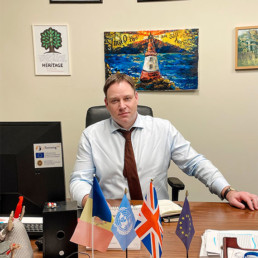
Written by Rob Ford
Rob is an educator for nearly 30 years, a history and politics teacher, a school leader in various schools in the UK and was principal of Wyedean School in the UK, before being appointed as Director of Heritage International School group.
“It is easier to build strong children than to repair broken men”. Frederick Douglass
One of the toughest challenges I have ever faced in my career is right now. How, as educators, do we present the World to our students without scaring them and conveying the impression that a grim dystopia awaits? It is not enough to simply “present the World” and its issues. The role of education is to allow the development of critical understanding and to impart our shared societal values.
Allowing students to voice their fears, to understand the World as it is in the 2020s with complex existential issues such as climate change, pandemics, nihilistic wars, deep inequalities and injustices, all around the globe, these are issues that adults find hard enough to comprehend in this tumultuous decade. But this is a challenge we cannot be scared of or vacate the arena as educators to the populists and the extremists in our midst. Educators cannot be scared of education.
Our role in education is to show it doesn’t have to be this way and the World could and should be a better place. Education isn’t a passive process or outcome. We are not on the sidelines learning abstractly. We need to ensure that our students, as the next generation, have some degree of hope that there are solutions and resolutions to create a more sustainable, equally, just and peaceful way in a realistic, non Panglossian way. And don’t forget to also teach them the beautiful human stories that exist and happen globally daily.
“At present the ways we organize education across the world do not do enough to ensure just and peaceful societies, a healthy planet, and shared progress that benefits all. In fact, some of our difficulties stem from how we educate. A new social contract for education needs to allow us to think differently about learning and the relationships between students, teachers, knowledge, and the world”. UNESCO Reimagining our futures together: a new social contract for education (1)
The perceived politicisation of education over the last decade in countries such as the US and UK, in an arena created with artificial and lazy constructs in terms and words such as “cancel culture” or “woke” has actually scared many educators from even attempting to explain global events, often sticking to a “teach them the facts only” without any values attached to this approach or critical thinking and understanding to unpack complex issues or historical and political events.
In the USA, this has been associated with America’s complex and difficult history around slavery, segregation, diversity and equality. The political issue of Black Lives Matter and high profile deaths of black people, coupled with the populism and nationalism of the Trumpian era, not only scares teachers in how they proceed but it scares students about the future full stop. There are extreme cases of states banning books and “critical race theory” has become a very thorny legal issue for many school boards and individual parents. US teachers and school leaders will end up leaving the system as these ‘culture wars’ continue (2). It seems odd that as Black History Month celebrations are an established feature of my schools in Moldova, more and more US schools are worried to even have such an important part of the school calendar.
In post Brexit Britain, the UK Prime Minister’s January 2023 announcement that students in England would study math up to 18, seemed to endorse the move away from schools “educating” students about the World and a policy approach in line with basic skills being the purpose of schools. At some point, these false binary dichotomies prevalent in education for too long be it “skills v knowledge” or “trad v prog” will disappear but it seems we have some way to go yet in the UK at least.
I have experienced these challenges all my career as a history and politics teacher, and as a school leader responsible for the moral, social and cultural values on the development of all the students in my care into well rounded, educated, intelligent, civic minded citizens and global citizens of the future. Teaching history in the city of Bristol, with its slavery legacy, was never an issue and we had brilliant engagement from community groups, local museums, the universities, the city council, in how we presented and taught local history. Standing by the empty plinth of Edward Colston this summer with my own children, talking about their city’s history, is part of that approach of educating not scaring.
As a former Head of 6th Form, the UK government would be wiser ensuring that all 16-19 year olds not only had career and work skills but also the ability to develop critical thinking, debating, dialogue in safe spaces and media literacy. The excuse of the ‘crowded curriculum’ often only on 3 A Levels doesn’t wash here when compared to the study programmes of 16-19 year olds around the globe. To hear good voices, informed ideas and views, through lectures and talks, different opinions, but all within the framework of accepted democratic society. This is the open mind set we want all students to develop. As the Head of Wyedean School, the highlight of my week was the 6th form critical thinking class in my room on a Thursday morning.
A much derided but set of guidelines that is worthy of a more detailed look are the UK’s guidelines on political impartiality in schools from 2022 that are actually very useful for all schools in helping shape the way they approach contentious and difficult topics or stories in the news. I have used some of these in the way I have adapted a workable approach and policy for my schools in Moldova when it comes to approaching tough issues, events and not to scare children. (3). The guidelines are a practical approach which is more useful than educators avoiding talking about the World for fear of scaring students. That is not the approach needed here either. Educators need much more support and training here as well. I managed to teach Thatcherism for A Level Politics for years without once bringing my own personal views of my father being a trade union leader and striking coal miner.
Moldova presented itself to me as a challenge as far as history and politics were concerned as a post-Soviet state, with a legacy of the Holocaust on its Jewish people, the immediate experience of many Moldovans to the Soviet deportations, as well as the troubled and complex recent history with near neighbours Russia, Ukraine and Romania. I lectured a group of trainee history teachers in Tomsk State University a few years ago and remember the booing and cat calls I got then in Siberia from future teachers who didn’t like the way UK schools taught the USSR and Stalin. I have never forgotten just how deep this shared cultural context & contested history goes for some in this part of the world.
I am proud of the way we have developed at Heritage, our inclusion, our approach to diversity, celebrating all our humanity in our international schools of over 25 nationalities. Doing nothing in Moldova is not an option. Education banishes fear and ignorance. I am very proud of the way we have developed and taught critical thinking (4) and debating skills, approached issues in a practical, age appropriate way such as climate change (5) and sustainable development, and brought the World into all classrooms daily with speakers in our Founders’ Lecture series (6) and partnerships with many countries. Our students take part in international COBIS debating tournaments, are active members of GSA international student councils and have worked in supporting the many refugees in the country from Ukraine. In 2023 we all still fear Russia’s war.
This was particularly needed in the last year as we dealt with the war on Ukraine and the impact on many in our community who had Ukrainian and Russian families. When we mourned the victims of Bucha in May 2022, following the national day of mourning in Moldova, our teachers and students found this much more useful & reflective than randomly having young children’s faces in blue and yellow. Teaching students badly, in a moral relative approach or just randomly about complex issues isn’t the right approach here either. Often more damage is done this way and students either get scared or de-sensitised to complex events and issues. An example here is the way history departments in many schools don’t want the Holocaust taught as a historical event through the reading of the ‘The boy in the striped pajamas’. This is about deeper learning.
“The aim of education is knowledge, not of facts, but of values”. William S Burroughs.
The mission of the Heritage international school’s founders is to prepare students confidently for the challenges of the future, not to hide them away from it or to make them scared and despondent of the World. This is my lodestar as a school leader as I continue to navigate through the uncharted and difficult waters of the 2020s ensuring all our students face the future not fearful but educated, confident and prepared for their World and how to change it for the better. In 2023, we need strong children more than ever and fewer broken adults.
References:
- https://unesdoc.unesco.org/ark:/48223/pf0000379707
- https://www.npr.org/2022/12/01/1139685828/schools-democracy-misinformation-purple-state
- https://www.gov.uk/government/publications/political-impartiality-in-schools/political-impartiality-in-schools
- https://www.educatorstechnology.com/2016/05/top-ted-ed-lessons-on-critical-thinking.html
- https://www.heritage.md/en/news/millions-of-teachers-and-students-worldwide-take-climate-action-together
- https://www.heritage.md/en/news/captivating-topics-and-remarkable-speakers-in-the-founders-lecture-series-2021-2022
Acceptance: Still so much work to be done.

Written by Kelly Richens
Programme Director, BASCITT. BASCITT is proud to celebrate diversity and promote equality and inclusivity (see here)
Applying to train to teach is a daunting enough task; the whole construction of your personal statement and how it defines you, all of your work experience, your qualifications and who will be your referees. All wrapped up in the deep emotions of taking this huge step towards becoming a life-changer for young people.
If this wasn’t searching enough in terms of self-exploration and presenting yourself, there is a section that says ‘Criminal Record and Professional Misconduct’ in which an applicant can make any relevant declaration.
I had an email confirming an application in which there had been such a declaration. Imagine my horror when I opened the webpage to view the application and read: ‘I am unsure whether this is a safeguarding issue, however I feel it necessary to raise and protect myself and others from misunderstanding. I am transgender.’
A flood of emotions ensued: rage that this applicant had felt being transgender could be a safeguarding issue; sadness that whilst she wanted to share this information, she had chosen to include in in a section labelled ‘criminal record’; fear that there are groups of people without the psychological safety to just be who they are without recourse of judgement; and the smallest amount of pride that she had actually been brave to share at all.
So rather than my first conversation with this applicant about her potential qualities as a teacher, I had to have a difficult conversation of reassuring and coaching her that she was in safe hands with us. What a shame that we could not talk instantly about her joy of her subject, or why she was applying to us. Her being transgender was a huge distraction from this and that is wrong.
Whilst I reflect on this, and have since interviewed and offered a training place to this lovely individual, based on her merit, I am still left without an answer of how do we stop this happening again? Keep promoting inclusivity? Keep the courageous conversations going? Keep educating and keep that positive momentum going on how we can continue to aim for a world in which an individual does not fear themselves being viewed through a judgmental lens? Instead a place where everyone can be celebrated for who they are and what they have to offer our pupils.
The Fight Against RSE

Written by Ian Timbrell
Ian is an education consultant and trainer, supporting schools develop their provision for LGBT+ pupils and their RSE curriculum. He has worked in education for 15 years; including as a class teacher and a deputy head teacher.
The cursory glance at social media and the internet suggests that UK RSE curricula include suggestions of bondage, is opposed by most people, is queering education and is a risk to safeguarding. But what is the truth behind this opposition?
The backlash
Broadly, objections can be categorised into three areas: secrecy around RSE; developmentally inappropriate materials; the inability to withdraw from lessons; and the ‘queering’ of education.
The secrecy around RSE
A common oppositional narrative is that schools refuse to show what materials they are using. This view essentially accuses all teachers of not safeguarding their children. We’re not asked to show all materials so why is RSE different? If schools were to publish every piece of planning and resource used, the workload would push an already overworked system to the brink of collapse. This is not to say that there is no transparency. Generally, schools will share this information upon request, or through parent consultations.
RSE is developmentally inappropriate
Opponents of RSE claim it contains messages of anal sex, bondage, pornography and self-stimulation at age 4-6. My son is 9 and I would be horrified if he learnt any of these at his age. But he’s not. Because none of it is in the RSE frameworks.
Proponents of this message often use excerpts of preparatory paperwork as evidence for inappropriate content. But these aren’t in the mandatory documents. As part of any curriculum design process, you look at a wide range of documents to find out everything that is out there. That doesn’t mean that Governments use them, or that you agree with them.
I am not saying that no school has ever used inappropriate materials, but critics fail to acknowledge that these mistakes are in the smallest percentage of schools and instead of banning RSE for all, the individual school should take the appropriate action to ensure appropriate nature of the materials they are using in lessons.
The inability to withdraw from lessons
In Wales, parents are not allowed to withdraw pupils from RSE lessons. Being told that we cannot withdraw our children from any areas of their life is bound to put some people’s heckles up. However, the reality is that this is the case for pretty much every other area of the curriculum. Schools would not allow withdrawal from English or Maths, so why should it be allowed from a framework that aims to develop healthy, happy people?
One of the reasons that withdrawing from all RSE lessons is not as simple as some would like you to think, is that effective RSE is primarily not delivered as ‘RSE lessons’. RSE encourages friendships and respect and so it is impossible to withdraw from any lesson that develops these attributes. What the parents here are generally saying is that they want them withdrawn from sex education and/or mentions of sexuality or gender. Withdrawing from RSE frameworks as a whole is impossible, but withdrawing from sections would be a logistical nightmare for schools and is not realistic.
The ‘Queering’ of Education
This phrase is fascinating, especially because it has no agreed universal meaning. Most opponents seem to be using it as a phrase to suggest that ‘Queer Theory’ is now underpinning education. They are conflating the true meaning of Queer Theory with conspiracy theories to suggest that there is collusion in education and health to somehow convert children to become LGBT+. This is rooted in LGBTphobia and is not founded on anything but discrimination and panic culture.
The real reasons for the backlash
The most obvious and largest group appear to be transphobic and homophobic. The reality is that up to 10% of the population are LGBTQ+ and if we do not ever discuss these things, this whole section of society will grow up wondering why they feel different. But also by deliberately not mentioning LGBTQ+ people, we are saying that they don’t exist, which is phobic in and of itself. Inclusion of LGBTQ+ people on displays, in books and in lessons is not going to turn anyone LGBTQ+, but it will make our world a more inclusive and tolerant place.
An argument opponents to RSE also use is that they don’t want sex talked about to three-year-olds. But sex doesn’t need to be mentioned. At that age, it’s about realising that there are different families and challenging gender stereotypes.
The final reason that I will talk about here is religion. A minority use religion as a reason for their children not to be ‘exposed’ to LGBT+ or gender discussions. I follow a number of LGBTQ religious individuals and organisations, and I can tell you that religion does not spread hate, people do.
Conclusion
In 2021, 5 parents took the Welsh Government to court to ban RSE. Unsurprisingly, they lost the court case as many of the disproved views from above were put forward as ‘evidence’.
The fact is, no matter what change happens in schools, there are always opponents and critics. But when you couple inevitable bemoaners with homophobia and transphobia, there was bound to be pushback. But RSE is key to making the UK an inclusive country and the vast majority of us know that it is the right thing to do and trust the teachers to do the best by their children.
Embracing Equity

Written by Ben Hobbis
Teacher, Middle Leader and DSL. Founder of EdConnect and StepUpEd Networks.
Equity (noun) – the quality of being fair and impartial.
This year’s theme for International Women’s Day is embracing equity. I have to admit over five years ago, if you asked me what this word meant, I could not have told you. I was uneducated and naïve in this area. I had to educate myself.
Five years ago, I would have said I was a champion for equality. I had done this in my previous roles in retail, particularly when it came to recruiting. In my last store, I had a very diverse team across the nine protected characteristics across the Equality Act. And this recruitment was not tokenistic, we had a fantastic team who were brilliant at what they did, and their diversity all brought something to the table. What I did not realise at that time was that I actually was a champion for equity, without knowing it. I was also an ally, but I did not recognise this either.
I believe I am a real champion for equity. This comes down to my allyship. As a white, able bodied, straight male, I have a duty to champion, advocate and push for equity. I see this in my day job as a teacher. As the champion for those 30 children who I serve, I must be the one to challenge decision making that directly impacts my children, decisions that affect them both negatively and positively. As a leader in a school, I must champion equity of opportunity. For example, as Personal Development Leader, one of the first things I enacted was to remove the Head Boy and Head Girl positions, they were limiting because of sex. We now have a mixture of students involved with our student leadership and pupil voice systems. And I am pleased to say in a boy heavy school, we have a large group of girls leading from the front and I am so proud to watch and champion them. As the leader of a grassroots network, I am constantly challenging colleagues in terms of the diversity of event line ups and who our intended audience is.
I recognise, I have not had it as hard as my female counterparts (but also my counterparts who are BAME, LGBTQ+ and so on). Therefore, I must embrace equity in my life and my work. We should all be striving to create an equitable society and not allow equity to be ignored. Embrace equity!
“Andrew Tate is a father figure to me” - lessons learned from talking to young people in schools
Written by Bold Voices
Bold Voices is an award-winning social enterprise preparing and empowering school communities to recognise and tackle gender inequality and gender-based violence through the delivery of educational talks, workshops, training and resources for young people, teachers and parents.
On January 3rd, the Bold Voices team arrived for our first staff training of the year. We love delivering staff training in schools, and we were excited to be back, if slightly unprepared for the early start and January rain. The session ran smoothly and the staff were engaged and passionate, all seemed as usual until we asked if there were any questions. Dozens of anxious hands shot up and they all had the same question – “what can we do about Andrew Tate?”
It wasn’t a surprise to any of the team, especially after the most recent news over the Christmas break, but the number of times his name has come up in schools in January has been unprecedented.
Back in July 2022 we began to hear students talk about Tate, and in order to get ahead of what we could see was a growing issue, Bold Voices released our Parent and Staff Toolkits to equip adults with the skills and confidence to have conversations about the ‘King of Toxic Masculinity’ with the young people in their lives. As the education sector catches up with the fact that this popular figure is not going anywhere anytime soon, we have seen a whole range of approaches to dealing with his popularity amongst teenage boys.
One strategy which we’ve seen is the blanket ban – sanctions for anyone who says his name in school. Another approach is whole school assemblies to speak about the harms of his content and messages. The young people we’ve spoken to don’t feel this works; they either say they feel silenced, or that the school is making too much of it. It is completely understandable that this is how many schools are responding. We certainly don’t have all the answers at Bold Voices, and we are always keen to hear back from other educators and parents who have found effective ways to address this issue (please let us know!) but for now we are encouraging schools to focus on one method that we know can have an impact: starting a conversation.
However, the reality is, these conversations are not easy. Here is a snippet of how they normally go:
“Miss, can I ask you a question? What’s your opinion of Andrew Tate?”
“Well, I’m much more interested in your opinion – what do you think of him?”
“He’s a top G miss. He teaches men how to be men. He makes money. He gets females. He’s a fighter. He is a traditionalist. He has four Bugattis. Those trafficking charges are lies. Those things he says? Taken out of context. Miss, it’s the Matrix. He’s a father figure to me.”
These conversations don’t always feel possible, or respectful, because these young people have internalised the message that anyone arguing against Tate is an idiot, hasn’t woken up to the truth, or they’re simply wrong. This makes it much harder to do our jobs – but we have seen success. In a school which had banned any mention of his name amongst pupils, when we opened up a conversation in a classroom, the feedback we received afterwards was: “I thought Andrew Tate was good but I realised what he does and all the hate against women.”
So what can we do to make more of those conversations successful? How can we move from fear of even starting a conversation, and those that go nowhere, to helping young people to choose for themselves if they want to continue to support Tate and his harmful messages?
Our response is three things (and they’re not easy):
STEP 1: TALK ABOUT HIM – BUT DON’T CONDEMN HIM
This can feel extremely difficult when the messages Tate puts forward are so explicitly dangerous and incite violence, but the more we condemn his words, the more we play into a right or wrong binary that pushes defensive teenagers even further away. Narratives around the Matrix incorporate the idea that there is a “great lie” going on, and figures like Tate (and Trump and other populists who brand themselves as anti-establishment) use this condemnation to push the idea: “that’s what they want you to think”. Break out of this binary by opening a dialogue and empowering young people to see all sides and opinions and to have the autonomy to make their own decisions about who they follow and believe. The aim should not be to have our children believe everything we believe because it’s scary when they don’t; we want to raise a generation of critical thinkers who can form their own opinions.
STEP 2 – MAKE ANDREW TATE UNCOOL AGAIN
This ties into avoiding condemnation – when we stand up and tell young people he is dangerous we give him notoriety and power. Andrew Tate has branded himself as the antidote to cancel culture, so his popularity is not tied to his morality. Not only that, his messaging around gender roles mean that he can discredit those who speak out against him with misogynistic myths – case in point, I asked a student if he would stop liking him if Tate was convicted for the trafficking charges and he said “well, the women are probably just lying for money and attention.”
Attempts to laugh at Andrew Tate have been more successful in damaging his reputation than pointing out how dangerous he is. The closest to this that I’ve seen is this twitch streamer’s video and Greta Thunberg’s infamous tweet. What I don’t like about these tactics is that they use old tropes of emasculation to put a pin in his puffed up performance of masculinity. Relying on his tools to tear him down won’t create meaningful change in the long run (we’ll just see a newer version of him spring up to his place).
STEP 3 – ASK THE RIGHT QUESTIONS
This brings us to the most important point – we need to change what questions we’re asking about Andrew Tate – instead of asking “what can we do about him?” we need to ask “what is it about him?” And “what is it about this current climate that allows his version of masculinity to thrive?”
His brand of masculinity is what draws people towards him: words like traditional, realist, role model for how to be a man. To most adults he looks like a cartoon of all the most ridiculous tropes of toxic masculinity; the cars, the money, the ideas about mental health. The alleged trafficking of women, the misogyny. So when we’ve looked at why he’s so popular the next question needs to be, what is the context and climate that means he is appealing?
When having these conversations I like to zoom right in, then all the way out. Instead of arguing his actual points with evidence or debating his intentions, I ask questions about what he represents, then look at the bigger picture, and ask why is that appealing right now?
The context in which boys are gravitating towards Andrew Tate is one in which they feel victimised and powerless. As an educator in the gender-based violence sector this can feel frustrating. But ignoring it and saying, “suck it up”, men have had power since the beginning of time, is not helping anyone.
Conversations around violence against women have completely transformed since I was at school less than 10 years ago. In a way that we can see paralleled with the movement for racial justice, conversations around gender-based violence have been radically shifted by events of the past decade: The #MeToo movement, Everyone’s Invited, Ofsted investigations, Sarah Everard’s death and many more. It’s confusing for young people.
Girls, trans and non-binary pupils have more awareness and knowledge than ever (thank you TikTok) about the ways in which they are victimised within a culture of gender-based violence. And they still suffer many different forms of this. But boys feel under siege too. They feel more under threat of being falsely accused than ever. Andrew Tate offers them a different narrative from the one in which they feel they’ve been cast as the baddies. There are no alternative models of masculinity on offer. We go into schools and tell young people that what Andrew Tate puts forward is an unrealistic stereotype of masculinity that ultimately harms everyone. Sometimes they see that, but when we exist in a system that punishes those who don’t fit a stereotype, we construct a reality where it is preferable to be an Andrew Tate rather than a man who can express his emotions and show weakness and vulnerability.
The quote at the beginning says it all. “Andrew Tate is a father figure”. This is how teenage boys feel when there aren’t any other role models for masculinity that seem valuable in today’s world.
The options are; see the problem with masculinity and try your best to not embody it, or go sit with Andrew, the realist, who can show you how to stop apologising for being a man in a world where stereotypes are just ‘the way things are supposed to be’.
As educators on this subject we can tell you that having these conversations on the ground is hard work. It’s a painful slog that feels unrelenting and sometimes futile. Watching boys copy his physical stance, treat me with suspicion, shout down my logic and questions and cling to their idolisation of him makes me realise something; they are clinging tightly because he makes them feel safe and understood. And taking that away is difficult and can feel cruel when we aren’t offering good enough alternatives. If it was anybody but Tate, I would never question a vulnerable year 9 boy’s father figure and role model. I’m so glad he has that. I wish it wasn’t one who would teach him that depression isn’t real, that he should value women as possessions, and that his worth is measured in what he can win, and how dominating he can be. I want to give him a hug.
LET’S COME BACK NOW TO OUR THREE SOLUTIONS.
1- Talk about him, don’t condemn him. At Bold Voices we will keep going into schools and having these conversations. And if you have young people in your life please use our toolkits to start having these conversations too. This part is the intervention and it’s more necessary than ever. The aim is not to condemn and create a right or wrong, it’s to open a dialogue where there is more than one narrative to choose from.
2- Make Tate uncool – but not him specifically and not through emasculation. Instead through promoting other role models of masculinity who seem more appealing than Tate. We look to people like Marcus Rashford, Stormzy, and Steph Curry (get in touch if you have others you promote!)
3- Look at the conditions that make Tate popular. Ask questions and don’t stop asking.
WANT TO LEARN MORE?
- Toolkit: How to Talk to Young People About Andrew Tate – Bold Voices
- Article: (7 minute read) How to respond to boys inspired by Andrew Tate Mark Roberts – TES
- Article: (5 minute read) Andrew Tate: How schools are tackling his influence Alice Evans – BBC
- Article: (6 minute read) What is going on with this Andrew Tate hand gesture? Sophia Smith Galer – Vice
HOW CAN WE HELP?
Bold Voices is an award-winning social enterprise preparing and empowering school communities to recognise and tackle gender inequality and gender-based violence.
Resources: Activities for the classroom, toolkits, blog posts and lesson plans for discussing gender inequality and gender based violence. Sign up to be the first to hear about new resources we create through our newsletter.
In Person Talks and Workshops: Discover our staff training, pupil talks and workshops, led by experienced facilitators and delivering on key topics relating to gender inequality and gender based violence.
A Mother Tongue: Not a Metric of Disadvantage
Written by Elen Jones
Director at Ambition Institute. Former teacher in South London and West Wales.
We celebrate International Mother Language Day on 21st February. Let’s re-frame the discourse around EAL and celebrate the wealth that comes with being multi-lingual rather than considering those who have EAL as deprived because of it.
I had a great aunt who once explained to me why she didn’t teach her children to speak her mother tongue: Welsh. She was a passionate educator, a teacher all her working life and she supported me in applying to and eventually attending university. She believed that learning Welsh would take up space in her children’s memories, space that could otherwise have been used for something more useful. So the children didn’t learn any Welsh.
Now since my aunt made that decision, over half a century ago, we know much more about the process of learning and how our memories work. Thanks to the awareness of cognitive science that is accumulating in the sector, we know that long term memory has huge capacity. No knowledge is going to fall out of a person’s long-term memory in order to accommodate another language. However, being EAL, having a mother tongue other than English, is often framed as a challenge at best, a disadvantage at worst. Seldom is the discourse a celebration of the diversity of language in our communities.
Language is the tool we use to communicate, to make meaning and to articulate our thinking. We can only use what we know to do this. The word for turquoise in Welsh is gwyrddlas, literally translated greenblue. In Welsh to think and the mind are the same word: meddwl. These subtleties of perception and understanding give those of us who are EAL more, not less, to think with and about. Studies into the cognitive processes of those who are bilingual have found a number of advantages for cognition.
Like any aspect of identity, each individual with EAL is shaped by their own experience and one’s mother language is just one aspect of identity that intersects with many others. Many EAL learners who enter the English education system early in their lives fare well, at least as well as those with English as a mother tongue. Those who enter the education system later tend to fare less well. Pupils who are EAL and live in poverty are less likely to make good educational progress than their peers. Supporting EAL pupils to progress along language levels and grade boundaries, and to become fluent in the languages of their communities, is important, of course; but in the drive to do so, do we sometimes omit the ways in which EAL pupils can enrich the understanding of others by sharing their perceptions and experiences?
On International Mother Language Day let’s actually celebrate. The diversity of language, and of thinking and culture that come with it, add huge wealth to our communities. The day-to-day support for people with different identities that translation, re-explanation and careful communication requires of us as members of communities with a range of mother languages builds inclusion. It’s a habitual reminder that we are all both other and the same in many regards.
I recently had a long train journey from London to North Wales. On the last leg I shared a seat with a German family. I speak almost no German. They spoke almost no English. The mother had two sons and the boys squeezed in between the two of us. I understood almost nothing of their conversation, but as a mother of young children I completely understood the efforts involved in trying to keep two energetic, hot, excited and travel-weary children entertained and contained for a long journey. The final part of the train journey follows the coast of North Wales along the Irish Sea. As the train approached the coastline one of the boys called out meer. In Welsh y môr, in English the sea. Without a common language we all knew what we were talking about.
Using language is one of the qualities that unites us as humans. Let’s celebrate the way in which we all use language, and all use different languages, to communicate and form communities. All else being equal (and too often it is not) pupils are richer, not poorer, for celebrating their mother tongue.
Darkness, Light and Legacy

Written by Serdar Ferit
Filmmaker, digital experience designer, and teacher who has won numerous awards and worked in over 20 countries on film, new media and education projects. Co-CEO of Lyfta.
Legacy
I founded Lyfta with my amazing wife, Paulina, 7 years ago, and since then we have built the most phenomenal team. Our journey started in 2004, with a story that inspired us, and over the years it has developed into our life’s work. Like many of the people we work with in education, we want our legacy to be one of big, positive and lasting change.
For those who don’t know, Lyfta is a learning space for children where they can access powerful, real-life stories through short documentary films and explorable immersive environments. We learn through stories and Lyfta is designed to teach children about the incredible and varied web of people and communities across the globe.
Legacy is something I have been thinking about a lot lately. Just as I thought Lyfta was finally finding its feet, with a complete team and a sense of a gear change on the horizon – a less intense one for me, I hoped! – I found out that I have colorectal cancer. This was in early October. The doctors initially said it was at an early stage and a slow grower, but after a couple of biopsies and numerous scans, in mid November, I found out that it has spread to my liver; stage 4. A bit of a curveball at 42.
The most difficult thing I have done in my life is telling our 8 year old son that I have cancer. Not being able to reassure him, with authenticity, that everything will be OK, triggered a cocktail of emotions I’ve not experienced before, and wouldn’t wish on anyone.
I’m not telling you this so you can feel sorry for me. I’m determined to beat this thing. I know that the key to this will be my frame of mind. I am a relentlessly positive person, but the last few months have been challenging in that regard.
Darkness and Light
I know I’m not the only one who has had a difficult period. Most of us have had a very challenging last few years. As a leader, part of my duty is to see the light, and to guide my team towards it. Over the last couple of years, light has not always been in abundance. At times, for many of us, things have been rather gloomy. But I think we all know that there is always light, no matter how dark it seems. This is something I’ve had to remind myself recently. And look for.
I am constantly nourished through the meetings I have with other people and the authentic human stories that we have curated and collected on Lyfta over the years. Stories move me. They have been invaluable in giving me different perspectives, in helping me see outside of my own world. Hearing about other people – what they achieve, who they love, the hardships they face and overcome – these stories sustain and change us.
Grown ups need stories too: a series of events to spread hope and inspiration. The amazing poet and storyteller Ben Okri said, ‘Stories can conquer fear and make the heart bigger.’ I think we need this at the moment – I certainly do. In an effort to inject some light and positivity into my life, and the lives of others, over the next year, I will be hosting a series of short online events where I will share short and powerful documentary stories that personify hope and resilience.
These online sessions will be for anyone who needs a lift or a bit of inspiration. A space where you will be able to put your worries to one side and be taken on a short journey. We will immerse ourselves into real human stories of resilience and hope, followed by a reflection exercise which will give you a space to express your thoughts if you wish to.
The Format
The sessions will be an hour long and there will be six over the coming year. We will explore two very different stories in each session, followed by a short reflection exercise, and, over the series, we will travel to at least 10 different countries. The stories are incredible and I am honoured and excited to share them with a wider audience.
There will be an opportunity to donate too, which will go towards subsidising Lyfta for all schools and provide a bursary fund for schools in financial difficulty, or with pupils in need or crisis.
Lighting the Way: Please Join Me
If you are interested in joining me for this journey, for one, some or all of the sessions, please register on the Eventbrite link. You could also get tickets for loved ones, colleagues, or even a whole team! The strength of the sessions will be the stories that we see and hear on screen, but it will be your stories too, and how we find and weave meaning in our lives – it will be that which will make these gatherings so powerful.
I look forward to meeting you around the virtual fireside, and finding the light to inspire us through 2023. I hope you can join me.