
Third Culture Kids Toolkit
Third Culture Kids Toolkit
Toolkit collated by Sophie Maclang and Amy Shuflin
What Are Third Culture Kids?
“A traditional third culture kid (TCK) is a person who spends a significant part of his or her first eighteen years of life accompanying parent(s) into a country or countries that are different from at least one parent’s passport country(ies) due to a parent’s choice of work or advanced training. The TCK frequently builds relationships to all of the cultures, while not having full ownership in any. Although elements from each culture may be assimilated into the TCK’s life experience, the sense of belonging is in relationship to others of similar background.”
Third Culture Kids: Growing Up Among Worlds (Pollock, Van Reken, & Pollock Third Edition 2017)
What Is the Third Culture?
- The third culture is the space between cultures created by growing up in multiple places.
- It’s a shared “third space” belonging with others who share similar globally mobile experiences.
- You don’t stop being a TCK when you become an adult. The experience of growing up in a third culture shapes the person that you become. The term reflects the formative years when you learn what is “normal” in an international environment; thus the term Adult Third Culture Kid (ATCK).
- TCKs can come from anywhere, it is the experience, not the passport.
It is important to note that TCKs belong to a group of people that have a lot of commonalities – CCKs or cross-cultural kids.
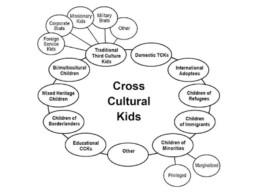
This diagram represents the “latest” model from Ruth E. Van Reken and Third Culture Kids: Growing Up Among Worlds (3rd edition) — the “Cross-Cultural Kid (CCK) Model
Want to Know How Many People in the World Are Impacted by Global Mobility?
We are collating a growing bank of resources to help you become more conscious, confident and competent as educators teaching Third Culture Kids and as leaders leading staff who are Adult Third Culture Kids. Here are some questions to reflect on:
- How can I be intentional about supporting a Third Culture Kid in my classroom?
- How can I recognize the different stages of transition in my students?
- How can we help children find their anchors when they are in transition?
- How can we support TCKs to process and acknowledge their losses?
- How does a mobile lifestyle shape or influence attachment styles across childhood and adulthood?
- How do I challenge my cultural assumptions when supporting TCKs?
- How can I champion TCKs and celebrate their strengths?
Articles
Ivy Chiu
Unseen experiences of non-white third culture kids: Exploring cultural hierarchy and social consciousness in transnational spaces
Academic Articles
Doherty, Lucy
Examining the Impact of a Third Culture Kid Upbringing: Wellbeing, Attachment and Ethnic Identity Strength in Adult Third Culture Kids
Donohue, C. (2022)
Growing up as a Third Culture Kid and Its Impact on Identity and Belonging. Counselling Psychology Review, 37 (2), 47–58.
Jones, E.M., Reed, M., Gaab, J., & Ooi, Y.P. (2022)
Adjustment in third culture kids: A systematic review of literature. Frontiers in Psychology, 13:939044.
Risch, R. (2008)
On the move: Transition programs in international schools (Doctoral
dissertation)
Schaetti, B. F., (2000)
Global Nomad Identity: Hypothesizing a Developmental Model (Doctoral
dissertation).
Tan, E. C., Wang, K. T., & Cottrell, A. B. (2021)
A systematic review of third culture kids empirical research. International Journal of Intercultural Relations, 82, 81–98.
Blogs
Books
Ota, Doug
Safe Passage: how mobility affects people & what international schools should do about it
Pollock, David, Van Reken, Ruth, Pollock, Michael
Third Culture Kids 3rd Edition: Growing up among worlds
Renée, Marci
My Tower is Tumbling!: A Conversation Story to Help Children Process Grief and Loss (Pierre’s World Traveling Adventures)